Kizito Okechukwu | September 16, 2026
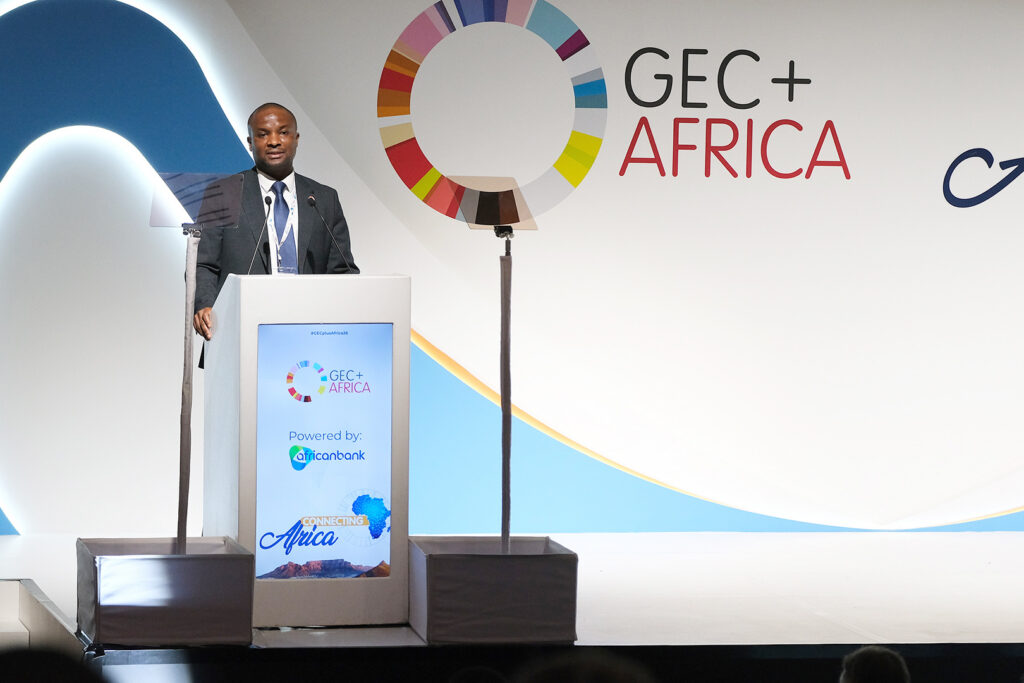
Cape Town International Convention Centre, Wednesday 16 September
Congress Theme: Connecting Africa
Good morning, ladies and gentlemen. It’s an honour to stand in front of you this blissful morning. I wish to send my special thanks to:
- His Excellency and Her Excellency, Kgalema and Gugu Motlanthe
- Acting Premier, Mr Simmers
- The Director-General (DG) of the Department of Small Business Development (DSBD), Ms Manzini
- Our Platinum partner and a strategic partner to 22 On Sloane, African Bank, led by Transformation Executive, Ms Edna Montse, and Group Chief Executive of Business Banking Keketso Motsoene
- Our Global Entrepreneurship Network (GEN) President, Jonathan Ortmans
- The CEO of Microsoft South Africa, Vukani Mngxati
- CEO of Small Enterprise Development and Finance Agency (SEDFA), Mr Nkosikhona Mbatha
- CEO of Amazon for Sub-Saharan Africa, Rob Koen
- The team from the City of Cape Town
- Wesgro
- Department of Economic Development, Environmental Affairs and Tourism (DEDEAT)
- Our other partners, Telkom
- Masisizane Fund
- Wholesale and Retail Sector Education and Training Authority (W&R SETA)
- United Nations Development Programme (UNDP)
- FirstRand Foundation
- National Empowerment Fund (NEF)
- And our other valued ecosystem partners here present especially the Entrepreneurs here today
In a special way, I also wish to thank my colleagues at 22 On Sloane and the various sub-committees of the local organising committee that have been working hard for almost one year now, meeting regularly and shaping the discussions we are all engaging in over the next two days.
In 2024, when we chose this theme for our Congress for GEC+Africa, it was inspired by an experience I had when in Lagos. I went to dinner with some friends and with my good brother, Wale, the GEN MD of Nigeria.
I asked the owner of the restaurant where the fish I ordered, which was now in front of me, came from. He replied that it was from Norway. And guess what? From Lagos to Norway is about 6000 kilometres, but from Lagos to Cape Town is about 4000 kilometres.
Africa’s paradox represents one of the most compelling economic contradictions of the 21st century: the continent holds immense structural opportunity, yet its wealth is consistently trapped by deep internal and external fragmentation.
How can we connect Africa if we as Africans are not connected? How can we connect Africa if we cannot move people freely? How can we connect Africa if entrepreneurship ecosystems in different African cities are not connected?
Our markets are severely isolated by expensive borders, uncoordinated regulations, and weak infrastructure. Logistics costs across Africa can be up to five times higher than in other regions, frequently making it cheaper to ship goods to Africa from Asia than between neighbouring African countries.
A key topic that has been in the media has also been the issue of migration – and we must ask the tough questions. How do we move people? How do we ensure that I have the same experience with infrastructure systems when I move from Ghana to South Africa or from Ethiopia to Egypt?
We must ask our leaders tough questions. Our leadership has been the cause of division and disconnection that we have faced as a continent. The continent spends billions annually importing food when it has the land to grow, while uncoordinated states risk entering a “race to the bottom” by undercutting each other’s trade terms with external powers.
The cost of disconnection means that Africa remains stagnant and its people won’t grow. We’ll have more people dying at sea while trying to cross to Europe. We’ll have poverty and more unemployment, with many of our youth remaining without jobs.
With the disconnection presents a great opportunity, however. Look at what the African Continental Free Trade Area (AfCFTA) presents. Like I said, for us to trade with each other, we must find a way to move people seamlessly.
Africa’s digital ecosystems are expanding rapidly, driven by mobile-first innovations, a young population, and major investments in connectivity. Mobile technologies contribute hundreds of billions of dollars to the continent’s economy, with Internet penetration reaching roughly 40%, and over 600 million mobile broadband users.
Financial inclusion has surged through mobile money and digital payment platforms, scaling locally adapted models from peer-to-peer services to embedded finance. Major tech and startup clusters have emerged across the continent, anchored by Nigeria, South Africa, Kenya, and regional hubs in Ghana and Senegal.
When I speak of ‘hubs’, I want to recognise our Cape Town hub team led by Khwezi Jackson, who has been steering the hub we launched 22 months ago with a young gentleman Alex that joined us 2 years ago fresh from Varsity. I also wish to recognise my good friend and colleague Carmen Rudd, who is our executive for operations and currently leading this congress together with the project management team Charne at al. She has worked hard to stabilise our operations we have at our Joburg campus post-Covid-19.
For Africa to connect, we need various role players such as governments across the continent to look at ways to harmonise our policies and ensure we create enabling environments for startups, micro, small and medium enterprises (MSMEs).
During this congress, we’ll also have many policy stakeholders engaging on different topics and trying to find solutions to the most pressing issues facing our ecosystem. I wish to recognise the efforts of Boitshoko Shoke, who is our Research and Impact Manager, and her team, Londani et al., who has been leading the content development for this congress, including the policy and research summit.
As investors, how do we ensure that we build enough patient capital to support the development of startups? We need to think of better financial instruments and alternative methods to ensure that capital reaches each and every entrepreneur who needs it.
Because of perceived systemic risks, international capital markets penalise the continent by an estimated $74.5 billion annually. In the same way as our African governments complain about expensive capital and penalties from international funding agencies, we must know that this is exactly what local entrepreneurs face when they don’t get capital from our development finance institutions (DFIs), banks and venture capitalists (VCs). We must ensure that capital is not expensive for them.
With that said, I wish to recognise Priyansh Dhawan, who is the CEO of Sloane Capital. We have recently acquired our CAT II licence and our National Credit Regulator (NCR) licence. We are now in the process of raising R1 billion in funding, or $63 million, to support startups and MSMEs across Africa which he’s leading.
As entrepreneurs, we must build scalable, cross-border solutions. We shouldn’t be scared to move beyond national borders. We shouldn’t be scared to break down doors and barriers that hinder access to markets. We need strong Entrepreneur Support Organisations (ESOs) that will ensure that we get our entrepreneurs market- and investor-ready to access the opportunities that the continent presents.
With that, I wish to thank my friend and colleague Bongani Ntombela, who is our Programme Executive and who has been leading our various capacity-building programmes.
As I close, I wish to say that connecting Africa is a shared responsibility. Africa’s future will not be built in isolation, it will be built through connection. The question is no longer whether Africa should integrate, but how quickly and deliberately we can make it happen. On a fragmented continent, connection is power. And in a connected Africa, opportunity becomes exponential.
As we talk about connections, I wish to introduce you to Kumii, which is an all-in-one digital platform that we have built to connect Africa’s entrepreneurship ecosystem. As part of our strategy to become a digitally transformed enabler that will drive scale in our ecosystem, Kumii presents the perfect platform to help all our efforts to scale and ensure we support more entrepreneurs, and that more startups and MSMEs have access to the resources they need to start, grow and scale. As much as we launched 22 On Sloane Cape Town hub as a legacy project post GEC+Africa 2024, this year, our legacy project is KUMii.
With this, please allow me to introduce to you my friend and the CEO of Kumii, Noma Ngubane.