Tsakani Nkombyane | October 14, 2026
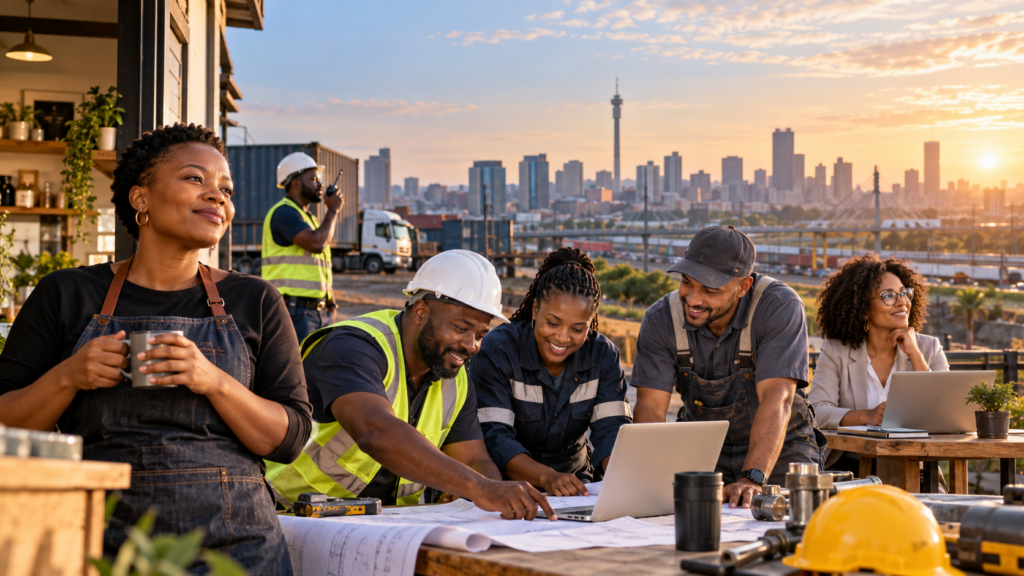
Across the country, people are starting businesses, creating opportunities and working towards financial independence. Yet, for many entrepreneurs, the dream of building a successful business becomes a daily struggle to survive. The challenge is not simply starting businesses, but creating an economy in which they can grow, compete, create jobs and remain sustainable.
Micro, small and medium enterprises (MSMEs) are central to this goal. Widely cited estimates attributed to the Banking Association of South Africa (BASA) suggest that small enterprises make up about 91% of formal businesses, employ roughly 60% of the labour force and contribute around 34% of GDP. Exact figures vary between sources, but they underline the economic importance of MSMEs and the need for an environment in which they can thrive.
Entrepreneurship extends well beyond retail, catering and informal trading. Businesses in plumbing, construction, maritime services, industrial maintenance, spill clean-up, exporting and industrial supply chains provide specialised services that support infrastructure, protect the environment and strengthen industries. Programmes such as the Industrial Maturity Assessment Programme help these businesses assess their operational capabilities, identify gaps and prepare to compete for larger contracts and join established supply chains.
However, technical expertise and ambition alone cannot guarantee success. Businesses need access to finance, equipment, procurement opportunities, reliable infrastructure, relevant assessments and training, and markets. Enterprise and supplier development programmes must therefore go beyond workshops and attendance certificates. Corporations, government departments and state-owned enterprises should create practical pathways for MSMEs to secure contracts, meet industry standards and build lasting relationships with buyers. Fair procurement processes, timely payments, mentorship and funding opportunities can help businesses move from survival to sustainable growth. Late payment, after all, is not only a cash-flow problem; it is also a source of personal strain for the people running these businesses.
Behind every enterprise, though, is a person whose wellbeing is often overlooked. As South Africa observes Mental Health Awareness Month this October, we must acknowledge the psychological demands of entrepreneurship. A global survey by Founder Reports of 227 entrepreneurs in 46 countries found that 87.7% reported at least one mental health challenge, with anxiety affecting 50.2%, high stress 45.8% and burnout 34.4%. The survey was self-reported, relatively small and not specific to South Africa, so its findings are indicative rather than definitive. Even so, they point to a concern that deserves attention.
For many entrepreneurs, financial pressure does not end when the working day does. Unpaid invoices, debt, uncertain income and the responsibility of paying employees can disrupt sleep, strain family relationships and create persistent anxiety. Business owners may feel compelled to appear strong and successful even when they are exhausted, isolated or afraid of failing. When personal identity becomes closely tied to business performance, a setback can feel like a personal defeat rather than a challenge that can be addressed.
Supporting MSMEs must therefore include supporting the people behind them. Accessible mental health services, peer-support networks, financial counselling and mentorship can help entrepreneurs navigate uncertainty. We must also create spaces where business owners can speak honestly about stress, learn from setbacks and seek help without shame.
Ultimately, entrepreneurship programmes must be measured by meaningful outcomes: businesses securing contracts, increasing revenue, creating jobs, entering new markets and becoming more resilient. Equally, success should recognise the human cost of growth and the importance of sustainable working practices.
South Africa’s future depends not only on how many businesses we start, but on how many we help to grow, how many jobs they create and how many lives they transform. We must build an economy where entrepreneurs can succeed without sacrificing their wellbeing. True success is not only about building stronger businesses; it is about creating a future in which both enterprises and the people behind them can flourish.