Khwezi Jackson | October 8, 2026
Late in August 2026, I had the opportunity to visit 14 townships across the Western Cape in search of product-based entrepreneurs. If approved, these entrepreneurs would form part of the Township Digital Market Access programme, which seeks to empower product-based township businesses with digital skills and guide them towards listing their products on leading ecommerce platforms in South Africa. That trip led me to reflect on our ability to produce goods and services as people of colour.
My great-grandmother used to make soap out of pig fat. She also made the most amazing amakhukhu (sleeping mats), traditionally woven from reeds or grass. My great-grandfather, though not a traditional healer, had the ability to create healing medicine by mixing indigenous wild plants. He was also a skilled farmer, managing plough fields and herds of cows, sheep and goats. My great-aunt made the world’s most beautiful lace curtains, and if anything needed to be sewn, there was no one else to take it to but her.
Thirty years on, I possess none of these skills that were once so prevalent in my family. Thirty years on, I cannot produce and be as productive as these family members once were and in reality, the skills they possessed are likely gone, never to be transferred to the children and grandchildren.
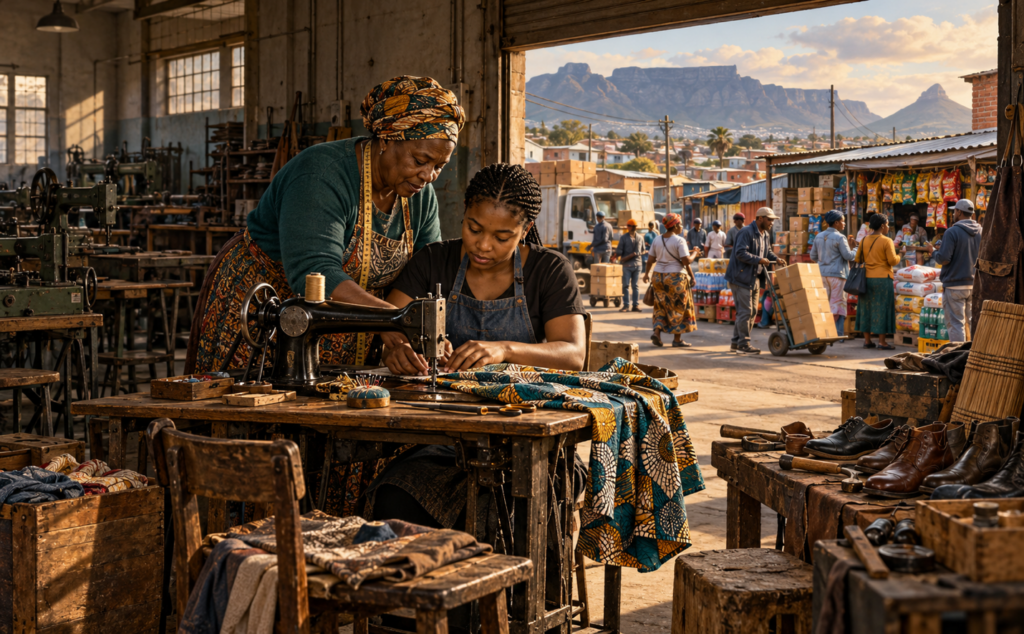
Reflecting on this with a development leader in a township in Worcester, we stumbled on a realisation. He told me his life story: his mother made clothes and his father made shoes. As a child, he watched both parents pour blood, sweat and tears into their venture, with most weeks of the year offering rest only on a Sunday. Throughout his childhood, the parents never achieved success from their ventures. In fact, they encouraged their son to pursue higher education so he could one day be employable. Just as they wished, their son has gained meaningful employment and as a country, we have lost a shoemaker, a designer and a seamstress.
In our search for entrepreneurs making products, we encountered many who are resellers of other brands. They are not creating, investing in manufacturing and innovation, or building their own brands alongside existing suppliers. By my estimation, there are likely more resellers in our townships than manufacturers of products.
We realised the problem is scale. Our parents and grandparents did not pass on their ventures and likely saw no future in which the scaling question could be answered. They never encouraged us to continue the family ventures, because their lack of success shaped a worldview that pushed us towards the employment route. Entrepreneurs of that generation were excellent craftsmen, but they lacked the resources, education and funding to scale and automate manufacturing, invest in innovation, and grow their markets beyond their geographic location.
The programme successfully recruited the entrepreneurs it required, people manufacturing their own products in various townships across the Western Cape. But I fear we risk losing more small-scale producer-manufacturers if this generation of entrepreneurs doesn’t answer the call of how we can make these products faster, better and at lower cost. Otherwise, we risk raising a generation of resellers masquerading as entrepreneurs.
To the parents and grandparents: please teach us the skills and abilities passed down to you, and together let’s find ways to revive family ventures. To government and support organisations: let’s be intentional about investing in township-based entrepreneurs for scale, and create market opportunities for them. The unemployment crisis we are in will not be solved by a proliferation of resellers, but by small manufacturers across industries rising up and expanding production spaces, which will create future employment opportunities. It is through scaling production and access to markets that those still in the trade will see the real value of sticking it out, making money and, hopefully, passing the craft on to future generations.