Londani Mpharalala | October 21, 2026
There is a question I now ask whenever I buy something, and it has nothing to do with price. Where does this rand go next?
It sounds like a small question. It is, in fact, the central question of local economics, and most of us have never been taught to ask it.
We tend to think of money as a quantity: how much we have, how much we earn, how much a product costs. Economists also care about its movement. A rand spent once is a transaction. A rand that is spent, earned, and spent again within the same community is an engine. The longer it circulates close to home, the more work it does.
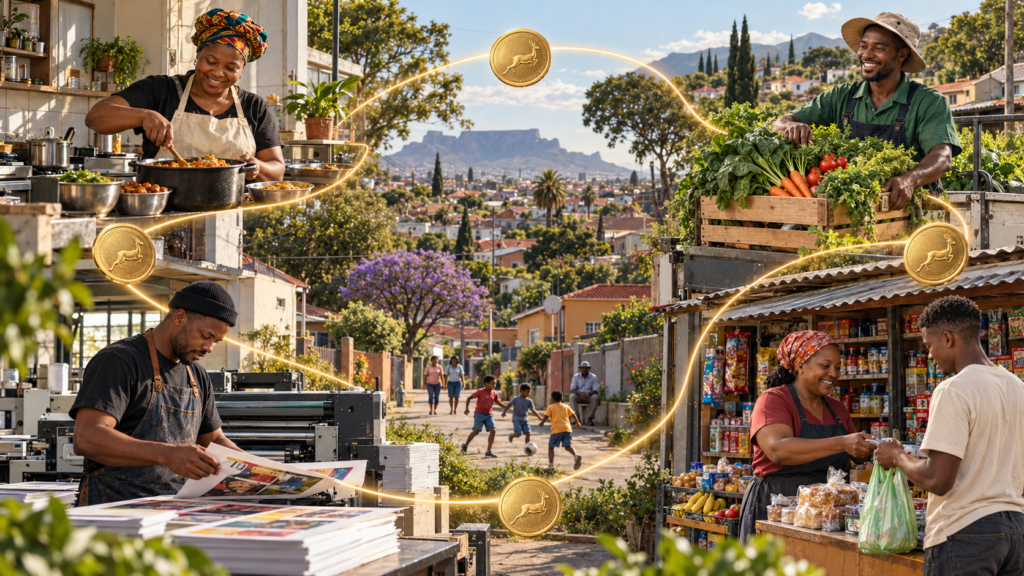
Picture two identical hundred-rand notes. The first is spent at a national chain, where most of it travels to a head office and shareholders far from the neighbourhood where it was earned. A small portion stays behind as wages. The second is spent with a caterer who runs her business from a home kitchen. She buys vegetables from a farmer down the road, pays a part-time assistant who lives two streets away, and settles her account with the printer who made her flyers. Each of those people spends part of what they receive in the same place. This is an illustration, not a statistic. But anyone who has run a small business will recognise the pattern at once.
Development economists call the difference between those two paths leakage. Money leaks out of communities through channels we rarely examine, and the communities that grow are often those that learn to plug the holes.
Plugging the holes does not require a grand intervention. It requires a thousand small decisions made differently.
In an earlier piece on conscious entrepreneurship, I wrote about how seldom business owners can say where their inputs come from. The same blind spot appears in our personal spending. We know the price on the tag. We do not know the journey behind it, or where the money travels afterwards. Awareness is the first intervention, and it costs nothing.
For entrepreneurs, this translates into a plain practical question: who are my suppliers, and could any of them be a neighbour? Before reaching for the cheapest online option, it is worth asking whether a local printer, a local packaging maker, a local designer or a local courier could do the job. Sometimes they cannot. Often they can, and they will remember you for it.
For consumers, it means treating the small choices as the real ones. The independent coffee shop over the chain. The hair stylist two blocks away. The spaza shop that has served the street for years. These are not charity. They are investments in the kind of neighbourhood you want to live in.
For larger institutions, it means procurement that does not close its doors to small suppliers before they have a chance to knock. Tender requirements that only a corporation can meet are, in effect, a decision about where the money will go. Breaking work into smaller packages, paying invoices promptly, and publishing opportunities where small businesses can find them are not favours. They are design choices with economic consequences.
I think often about how this plays out in the work I see through 22 On Sloane. Early-stage founders rarely fail for lack of ideas. They fail in the long gap between having a product and having enough customers to pay the rent. In that gap, a local purchase is not a rounding error. It can be the difference between a business that survives the quarter and one that does not.
That is the part we forget when we talk about scale. Big businesses were small once, and the thing that carried them through was almost never a headline investment. It was a customer who paid on time, a supplier who extended a little trust, and a community that chose them when it could have chosen otherwise.
There is a cultural point here too, and it is worth saying plainly. South Africans are practised at celebrating large, visible acts of generosity and far less practised at recognising the economic power of ordinary, repeated choices. We admire the donation. We underrate the weekly shop.
Yet the weekly shop, multiplied across millions of households, is where much of the country’s economic life actually happens. If even a modest share of it moved towards locally owned businesses, the effect would be felt in wages, in job security, and in the confidence of people who are considering whether to start something of their own.
None of this means abandoning price, quality or convenience. A local business that overcharges and underdelivers does not deserve loyalty, and the best ones know it. The point is simply to add a second question to the first. Alongside “what does this cost?”, ask “where does this go?”
Growing an economy can feel like something that is decided far above our heads, in budget speeches and boardrooms. In practice, a good part of it is decided at tills, on invoices, and in WhatsApp orders placed on a random Tuesday afternoon.
Where will your next rand go, and who will it reach after you?