Noma Ngubane | August 7, 2026
South Africa does not lack effort. It lacks systems that let effort compound, and the way we fund, procure and praise our way around that failure makes it worse.
“It is still in our hands to combat poverty and inequity.” I believe that. But the uncomfortable word is “our”. Whose hands, exactly? And what are those hands already doing?
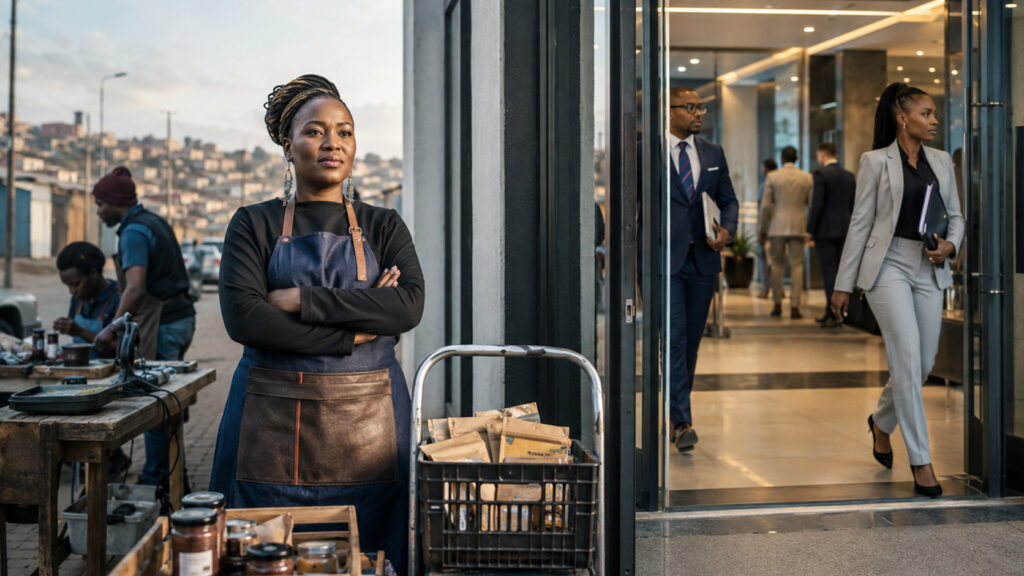
They are not idle. They are opening doors. Funders decide who is investable, corporates which suppliers are ready, institutions who is credible. Almost always the doors open for those who already hold the keys; formal records, collateral, the right network. We have built an apparatus for fighting poverty easiest to enter for those fluent in its language. Then we call it progress.
People are trading, repairing, cooking, transporting and building. What is missing is not discipline or ambition. Call it the conversion gap, the distance between economic activity and economic mobility. Between a promising idea and a fundable business.
This is the cruelty of it, need and proof run in opposite directions. The founder most in need of a first contract is least able to show the readiness it requires. The trader with customers, discipline and demand has no formal records. Neither is failing. The door is not built to open for them. In South Africa this is not accidental. Exclusion was engineered, and its geography holds.
The discipline is not missing, it runs outside the banking system. The International Finance Corporation puts the emerging-market MSME finance gap at US$5.7 trillion, rising to US$8 trillion once informal enterprises are counted. The invisible are that missing US$2.3 trillion, absent even from the measurement of their own exclusion.
The World Economic Forum calls this a problem of legibility rather than behaviour, describing a blindness that runs both ways. The diagnosis is right. The symmetry is not. Blindness suggests two parties equally unable to see. Only one can choose to look, and only one decides what counts as proof. That side is us.
What we call risk is unfamiliarity expressed through formal criteria. This is where the conversion gap stops being an entrepreneurship problem and becomes one of institutional design.
Here we let ourselves off the hook. We have learned to admire resilience. The admiration is sincere. It is also a substitute for change. Praising people for surviving a system we have not fixed is a way of not fixing it. Resilience is what people supply when the structure supplies too little. It is not a policy. It is evidence that we ask the most of the people with the least to fall back on.
We will not admire our way out of poverty. Nor will we incubate, fund or procure our way out while the rules of entry favour those closest to the door.
If the task is still in our hands, the honest response is not to admire harder. It is to change who gets in, how they get in, and what counts as proof when they arrive.
For funders, proof must move beyond collateral and audited statements. Transaction behaviour, delivery history, customer consistency and evidence of demand must count.
For corporates, the work is to build supplier readiness rather than demand it upfront. A bar set at “already proven” will favour incumbents.
For government and development agencies, it means funding the unglamorous work of visibility the records, registrations and credit histories that make invisible enterprises legible.
For ecosystem builders, it means measuring success by whether participation widens, not by a cohort’s polish.
This is the problem we work on at 22 On Sloane through Kumii, making entrepreneurs and MSMEs visible and credible to the institutions that decide. Technology will not end poverty. But friction can be engineered down.
A question, then, for anyone who holds a door. The next time a business crosses your desk without records, references or polish, ask whether you are weighing its potential or its paperwork, and whether your standard finds readiness or keeps out those still building it.
It is still in our hands. That was never the comforting part. The doors are ours. The keys are ours to cut. And the gap we keep asking people to leap unaided is ours to close.
Noma Ngubane, KUMii Chief Executive Officer, Powered by 22 On Sloane